Mobile Notes: One Install Is Not Enough Anymore
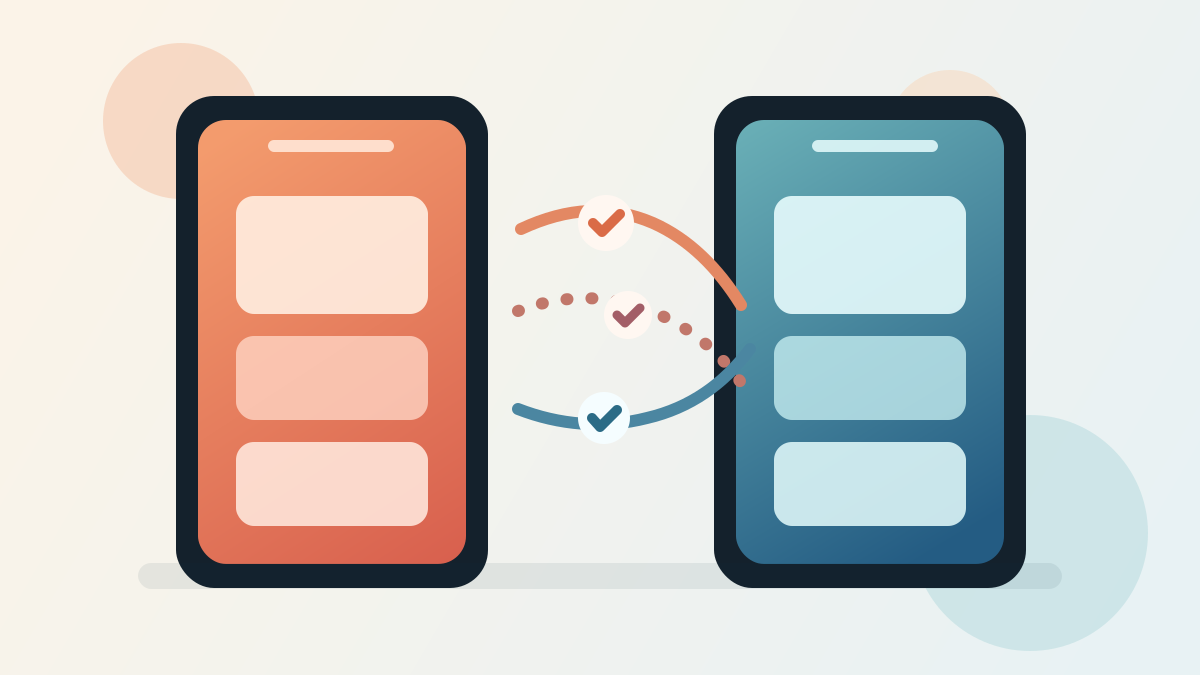
I used to be pretty happy with one install of the app on my phone.
One App Store build if I was checking production. One dev build if I was actively in the code. Maybe TestFlight for a week before release if we were feeling disciplined.
That setup feels thin now.
As of Tuesday, August 4, 2026, the most useful thing I can do for a mobile app is keep the shipping lane and the rehearsal lane alive at the same time. Not as branches in Git. Not as a half-remembered Jira ticket that says "beta test later." I mean two real, launchable states I can tap on a device. One is the build I trust today. The other is the build that is about to become my problem.
That idea keeps showing up in the official platform guidance, even when the platforms phrase it differently.
Apple is already asking for two lanes
Apple's submission floor is stable and explicit: since April 28, 2026, App Store Connect has required apps to be built with Xcode 26 or later using the iOS 26 family of SDKs. At the same time, Apple's release feed shows the next lane moving right beside it: Xcode 26.6 shipped on June 25, 2026 and Xcode 27 beta 4 landed on July 20, 2026 alongside iOS 27 beta 4.
That is not a weird summer exception anymore. That is just the shape of Apple development now. There is always a shipping floor and a future floor.
Apple's own Xcode pages lean into that workflow. The current Xcode overview and What's new in Xcode 27 focus on coding agents, previews, testing tools, and Device Hub rather than pretending source code is the whole job. My interpretation: Apple expects more of the development loop to happen with runtime behavior close at hand, not after the merge when somebody finally opens a simulator.
So the practical Apple setup I want looks like this:
- Keep the current shipping Xcode installed.
- Keep the current beta Xcode installed separately.
- Run the ugly flows against both: auth, camera, purchases, deep links, share sheets, notifications, keyboard-heavy forms.
- Give the rehearsal app its own icon or name so I never have to wonder what I am testing.
That last part sounds trivial until you open the wrong build at 11 p.m. and bless the wrong thing.
Android and cross-platform are pushing the same habit
Google is saying the quiet part out loud now. Android 17 shipped on June 16, 2026, and Google describes it as a shift to adaptive-first development standards, including mandatory large-screen resizability. That is a platform-level way of saying the "phone first, maybe tablet later" bargain is expiring.
The rehearsal lane on Android is not only "next OS beta." It is also "next screen shape," "next window size," and "next system bar expectation." If your app only feels coherent in one narrow phone state, the platform will find you eventually.
React Native makes this a lot more actionable than it used to. React Native 0.86, released on June 11, 2026, brings comprehensive edge-to-edge support on Android 15+ and is the second release in a row with no user-facing breaking changes. I like boring release notes when I am trying to improve a workflow. A calmer upgrade window is exactly when I want to stage the next build, fix insets, and clean up bar and keyboard behavior without also fighting framework drama.
Expo is unusually concrete here. Its official docs say it is common to install development, preview, and production variants on the same device, using unique Android application IDs and iOS bundle identifiers so you can work in development, preview the next version, and still keep production installed. I do not think that is only an Expo tip. I think it is one of the better mobile engineering habits available right now.
I want that same posture even when the stack is not Expo:
- Production stays boring.
- Preview is allowed to be slightly uncomfortable.
- The preview icon should look different on purpose.
- The preview build should get the weird user flows first.
If the first time I learn about an inset bug, foldable bug, or deep-link regression is after the release candidate is already blessed, I did not have a rehearsal lane. I had optimism.
Flutter and MAUI are saying it in their own accents
Flutter's current iOS story is one of the clearest examples. The official Flutter docs say that as of Flutter 3.44, Swift Package Manager is on by default for iOS and macOS. The same docs say Flutter still falls back to CocoaPods for dependencies that do not yet support SwiftPM, and they remind you that the CocoaPods registry becomes read-only on December 2, 2026.
That is exactly the kind of ecosystem shift I do not want to discover all at once in my shipping lane. I would rather keep the stable app boring while I run the next toolchain, the migrated plugin graph, and the suspect build scripts in parallel for a week or two.
.NET MAUI lands on the same conclusion from the other side. Microsoft's docs say the focus of .NET MAUI in .NET 10 is product quality, and they make a workflow point that I think deserves more attention: MAUI now ships as a .NET workload plus NuGet packages so you can pin projects to specific versions while also previewing unreleased or experimental builds. That is version-lane tooling. It is the framework giving you a way to separate "what we ship today" from "what we need to prove next."
The detail that makes this real for me is not the packaging model by itself. It is what usually rides along with it: deprecations, handler changes, build image assumptions, native SDK drift, one small iOS behavior fix that turns out to matter more than the headline feature. Those are rehearsal-lane problems.
What I would actually do this Friday
Not a giant process overhaul. Just a few habits:
- Keep two toolchains when the platform supports it. Current stable. Current next.
- Keep two installable app variants on a real device whenever possible.
- Make the non-production variant visually obvious so mistakes are hard to make.
- Route the boring, high-value flows through the rehearsal lane first: login, purchase, push tap, share, camera, offline recovery, app updates.
- Use calm framework releases to pay off platform polish, not just to check the upgrade box.
I used to think this was overkill for smaller teams. I do not anymore. Mobile releases have too many moving surfaces now: store rules, beta SDKs, device classes, framework migrations, native dependencies, OTA paths, form factors, system UI changes.
At this point, I want the future build sitting right next to production, where it can start bothering me early.
Sources
- Apple Developer Upcoming Requirements
- Apple Developer Releases
- Xcode - Apple Developer
- What's New in Xcode 27
- Android 17 is Here
- Adaptive development for the expanding Android ecosystem
- React Native 0.86 - Edge-to-Edge and DevTools Improvements, no breaking changes
- Install app variants on the same device - Expo Documentation
- Swift Package Manager for app developers - Flutter Docs
- What's new in .NET MAUI for .NET 10 - Microsoft Learn