What Azure AI Fundamentals Taught Me
When I started working through Azure AI Fundamentals, I expected a survey course. A quick pass over services, a few definitions, maybe enough vocabulary to sound less confused in meetings.
What I got instead was a better mental model for how AI products actually come together — not magic, just engineering with a different set of failure modes.
AI is not one thing
The first thing that stuck was how broad the word "AI" actually is in practice.
It's easy to talk about AI as if it means chat. But the fundamentals material keeps pulling the scope wider. Language tasks, vision tasks, speech tasks, document extraction, search, recommendation, prediction, and now generative experiences layered across all of it.
That matters because product decisions get worse when we flatten all of it into "use a model." Sometimes the right answer is generation. Sometimes it's classification, or OCR plus validation, or just search with better indexing. Sometimes the smartest thing you can do is avoid a heavyweight model entirely and choose the simpler system with clearer behavior. That's easy to forget when the market keeps rewarding the most dramatic demo.
Good AI products are mostly about grounding
Useful AI systems depend less on raw cleverness than on context. A model without the right grounding is confident in all the wrong ways. It can sound polished while missing the actual point of the task.
Working through Azure's approach to search, knowledge extraction, and document-based workflows made this more concrete. If the system needs facts, it needs access to reliable facts. If it needs to answer from documents, document quality and retrieval quality matter as much as prompt quality.
That changed how I think about AI architecture. The interesting question is often not "which model should I use?" but "what does this model need in order to be right often enough to trust?" One of those is a vendor question. The other is an engineering question.
Responsible AI is not a compliance footnote
Azure AI Fundamentals frames responsible AI as a practical discipline, not an ethics section you skim. I liked that framing because it makes it operational.
Bias, privacy, harmful output, weak transparency, overconfidence — these aren't abstract topics when you're building something real. They turn into product bugs. Sometimes serious ones.
The checklist that stuck with me: know what your system should and shouldn't do, be honest about uncertainty, protect sensitive data, keep a human in the loop where the cost of being wrong is high, and evaluate for failure cases, not just happy-path demos. Not revolutionary, but worth writing down because teams skip it.
The pipeline is the product
Before this, I underrated how central search and document processing are in modern AI systems.
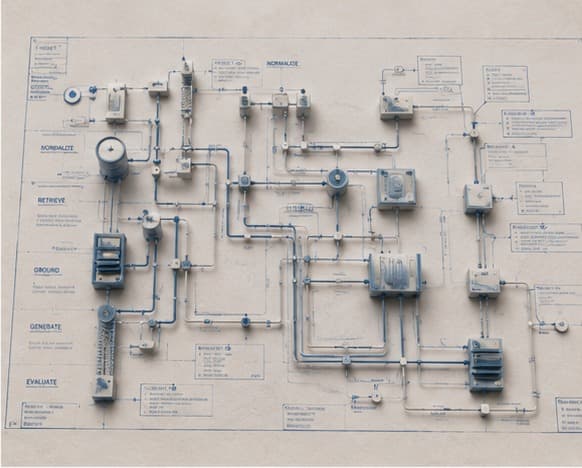
The flashy part of AI is usually the generated answer. The unglamorous part is the pipeline that makes the answer useful: ingest the data, clean it, chunk it well, index it, retrieve the right pieces, and preserve enough structure that the model can respond with something specific instead of generic.
That pipeline is where most of the actual product quality comes from. It also explains why so many AI features feel impressive in demos and weak in production. The model gets the attention, but the retrieval layer is usually what determines whether the experience feels trustworthy.
Evaluation is where engineering maturity shows up
It's easy to be impressed by a single good output. It's much harder to ask whether the system performs reliably across ambiguous wording, incomplete documents, messy edge cases, and situations where the right answer is "I don't know."
The more I learn about AI systems, the more I think evaluation is where the serious work is. Not the prompt that works once, but the process that tells you when it stops working, where it's weak, and whether it's safe to ship.
That includes user-facing questions too: Does the response match the source? Does the interface communicate uncertainty? Can the user verify what happened? Does the workflow recover well when the AI gets it wrong?
What I actually took away
The biggest shift was stopping to treat the model as the whole system.
The real work is in the surrounding design: choosing the right kind of AI capability, grounding it with usable data, building the retrieval and document flows carefully, evaluating beyond the happy path, and making deliberate decisions about where human judgment belongs.
That's the part I find encouraging. Building good AI products isn't only about chasing the newest model. It's still engineering. Just with a sharper penalty for pretending uncertainty is certainty.